
DevOps for Small Business Operations: An Illustrative Example
Discover how Momma Mia, a food and beverage distributor, implemented a DevOps purchasing system to revolutionize their operations.

If you’re a small business owner trying to streamline operations, you’ve probably heard the terms DevOps and Scrum thrown around — usually in the context of companies much larger than yours. The question worth asking isn’t whether these methods exist. It’s whether they actually translate to a business your size.
To make that concrete, this post walks through an illustrative example: Momma Mia, a fictitious food and beverage distributor, and how a DevOps approach to a single purchasing system could play out from problem to result. None of this is a real client engagement — it’s a worked example meant to show the mechanics of the approach, not a documented case study.
The Challenge
Momma Mia runs its operations on an Oracle database hosted on HP-UX servers, with purchasing and accounts payable handled as separate processes within that same database. Leadership wants to streamline procurement by adding a purchasing module — but the IT team is already stretched thin, with no spare capacity for a project of this size.
The Approach
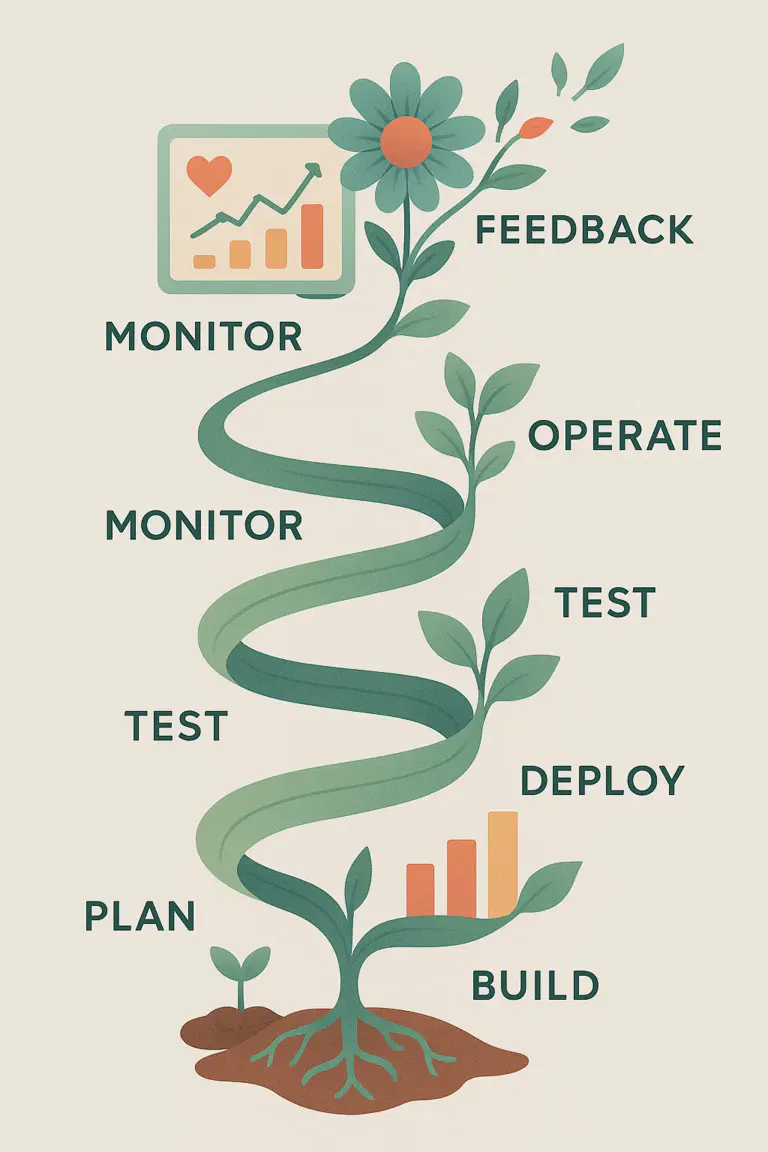
Momma Mia adopts DevOps — combining development and operations into one continuous process — paired with Scrum to manage the project itself. Together, they bring three things a stretched IT team needs most: transparency across the process, frequent inspection and adjustment rather than a single big-bang launch, and real collaboration across departments that don’t normally work side by side.
The goal: build a management tool that automates the redundant, manual parts of purchasing.
The team: a cross-functional group pulled from IT, purchasing, and accounts payable — not just developers.
The cadence: daily stand-ups, sprint planning, and retrospectives, so problems surface early instead of at launch.
The Technical Build
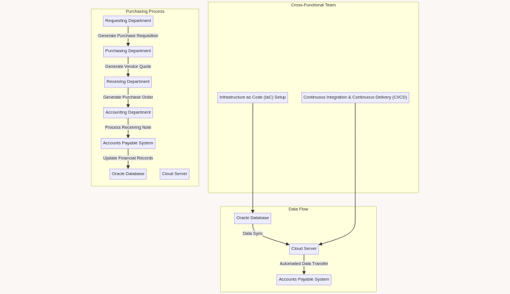
The first step is database integration. The IT team uses Infrastructure as Code to provision a new cloud server and configure it to host the purchasing module — no manual server setup, and a repeatable process if they ever need to do this again.
From there, a CI/CD pipeline automates testing and deployment. Code changes are automatically built and tested, and changes that pass move to deployment without someone manually pushing them through. (For a real-world version of this kind of database modernization — not hypothetical — this retail information system transformation covers a multi-year migration from a flat database to a relational one, with the same governance-first sequencing.)
Cross-Team Collaboration
The purchasing team works directly with IT to define what the module actually needs to do, using Agile methods to break the project into small, deliverable pieces rather than one large specification handed off and built in isolation. Accounts payable plays a real role too — not just as an end user, but in defining how invoices and payments should flow once the new module is live.
How Scrum Kept It on Track
Scrum gives the team a structure that’s flexible enough to absorb new requirements without losing the thread of the project. In practice, that means planning sessions at the start of each sprint, daily check-ins to catch blockers early, weekly reviews, and a retrospective at the end of every sprint to ask what actually worked.
The daily stand-ups kept the team aligned and made roadblocks visible before they became delays. Sprint planning gave the work a clear shape. The retrospectives are arguably the most valuable part — a built-in moment to ask what should change before the next sprint starts, rather than waiting until the whole project is finished to find out something didn’t work.
What the Project Delivered
Across the engagement, the new system delivered improvements in a few distinct areas:
Process. The purchasing process is automated and integrated directly with the existing Oracle database, with data flowing cleanly between purchasing and accounts payable instead of requiring manual reconciliation.
Visibility. A real-time dashboard gives the team complete visibility into purchasing operations, with proactive monitoring that surfaces issues early and reporting that actually supports decisions instead of just documenting what already happened — the same underlying case I make for strong data platforms generally, just applied to one specific workflow.
Cost and efficiency. Automation and cloud infrastructure reduce manual processing and the errors that come with it, with resource allocation that scales rather than requiring a hardware refresh every time volume grows.
Technical foundation. The purchasing module sits on a well-designed database architecture with real security measures in place, and integration that keeps data consistent across systems rather than introducing new discrepancies.
Organization. Cross-team communication improves simply because purchasing, accounts payable, and IT are now working from the same sprint cadence and the same visible backlog.
What It Cost — and What It Returned
The total investment — software, labor, and training — came to $55,000. Here’s roughly how that played out against the alternative of a traditional implementation:
| Cost Category | Traditional Approach | DevOps Approach | Result |
|---|---|---|---|
| Manual data entry | High labor cost, recurring errors | Automated integration | Meaningful reduction in both |
| Infrastructure | On-premise servers | Cloud scaling | 40–60% lower infrastructure cost |
| Maintenance | Ongoing dedicated IT support | Automated management | Substantially lower overhead |
The bigger driver of ROI wasn’t any single line item — it was timing. Process automation eliminated manual data entry between purchasing and the Oracle database. Cloud infrastructure scaled dynamically instead of requiring a hardware purchase. And because the team worked in short, reviewed sprints, problems surfaced and got fixed while they were still cheap to fix, rather than after the system had already shipped.
The $55,000 investment is the kind of cost that pays for itself through fewer errors, lower infrastructure overhead, and a system that scales without a second major investment — not instantly, but well within the kind of timeline that makes the case for doing it this way instead of the traditional route.

Mapping the Data Flow
Before writing a line of code, the team built data flow diagrams to trace exactly how information would move from one stage to the next. That step matters more than it sounds like it should — it’s much cheaper to catch a broken handoff on a diagram than to discover it in production.
Designing the Database
An entity relationship diagram mapped out how the purchasing data should actually be structured — which tables exist, and how they relate to each other through primary and foreign keys. The team applied standard normalization techniques to reduce redundant data, keep the database efficient, and protect data integrity as the system grew.

How the Automation Actually Worked
Infrastructure as Code automated the creation of virtual machines and the configuration of the software running on them — which meant faster setup, consistent environments every time, and a repeatable process for whatever Momma Mia needed to scale next.
The CI/CD pipeline did the rest: automated testing caught issues before they reached production, deployment of new features happened on a predictable cadence instead of an ad hoc one, and the whole process became more reliable simply because it wasn’t dependent on someone remembering every manual step.
By embracing automation, Momma Mia’s hypothetical purchasing system could move from manual, error-prone processes to something that scales with the business instead of working against it.

Rolling It Out in Sprints
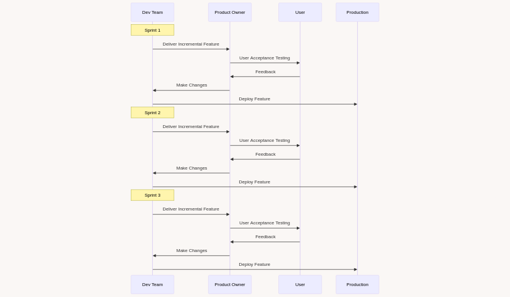
Rather than building the entire module and launching it all at once, the team delivered it incrementally — small, working pieces of functionality in each two-week sprint, with user acceptance testing at the end of every sprint and real feedback folded into the next one. That kept the project on track while keeping management and end users involved throughout, instead of surprised at the finish line.
What This Kind of Approach Tends to Deliver
In a scenario like this, the realistic gains tend to fall into a few categories:
Operational. Meaningfully faster purchasing cycles, lower operational overhead, fewer errors from automated validation, and a system architecture that can grow with the business instead of needing to be rebuilt at the next growth stage. For a sense of what these gains actually look like outside a hypothetical, this field service transformation case study documents a real 40% reduction in dispatch time and a 25% increase in completed jobs per week from a comparable shift away from manual coordination.
Collaborative. Better communication across departments that don’t normally talk daily, more visibility into where a project actually stands, and clearer ownership of who’s responsible for what.
Strategic. A streamlined procurement process, a credible answer to “can a small business actually pull this off,” and a real return on investment even on a budget far smaller than what’s typically associated with enterprise IT methodology.
Where This Leaves You
If you’re a small business owner looking at your own version of Momma Mia’s purchasing problem, the lesson isn’t “go hire a DevOps team.” It’s that the underlying discipline — short iterations, cross-functional ownership, automation where it actually reduces error, and feedback loops that catch problems while they’re still cheap to fix — scales down further than most people assume. If your version of this problem currently lives in a spreadsheet rather than an Oracle database, these are usually the earlier warning signs worth checking first.
If you’re trying to figure out whether something like this is the right fit for your operations, or whether the real problem is somewhere upstream of the technology entirely, let’s talk — or take a look at how I structure these engagements before committing to anything.
Acknowledgements
This article was developed in collaboration with generative AI technology. ChatGPT (GPT-4o, OpenAI) assisted with brainstorming and structuring. All content has been reviewed, edited, and approved by Sondra Hoffman, who takes full responsibility for the accuracy of this publication.
Further Reading
- What Is DevOps?, Atlassian.
- The Scrum Guide, Scrum.org.
- What Is Infrastructure as Code (IaC)?, Red Hat.
- Continuous Integration vs. Delivery vs. Deployment, Atlassian.
- What Is Agile?, McKinsey & Company.