
California's Food System Vulnerability: A Research Report
Research report examining California's food system resilience and the promising strategies emerging to strengthen local food security.
Executive Summary
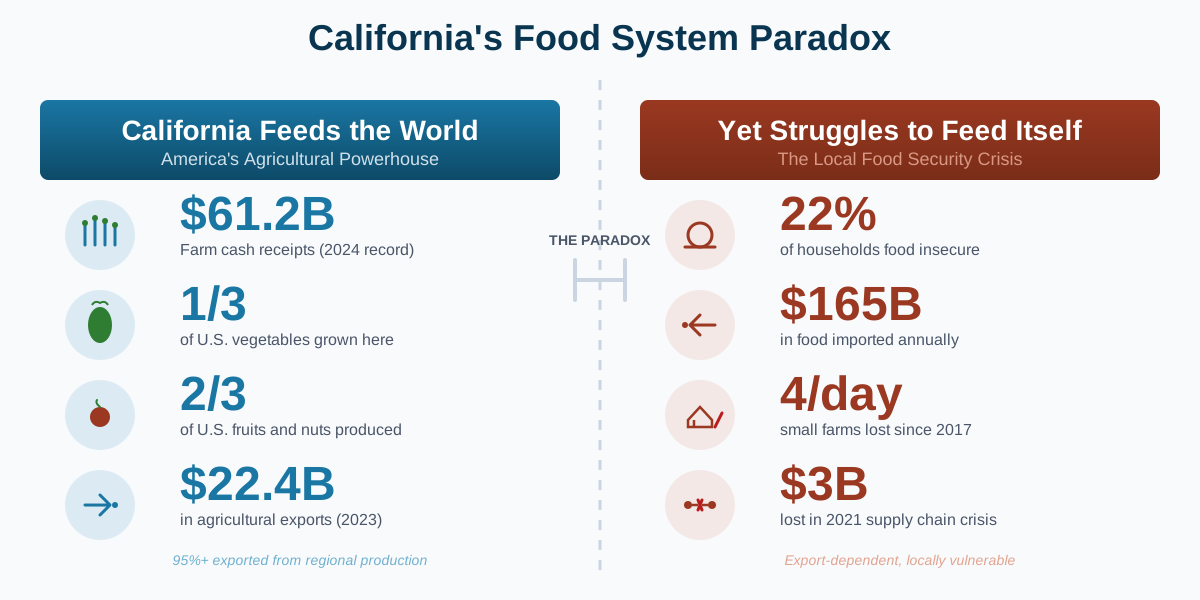
A few years ago, I became concerned about California’s food system vulnerability during supply chain disruptions. My initial analysis revealed troubling patterns—despite being America’s agricultural powerhouse, California exports over 95% of what it grows while 22% of households face food insecurity.[6][5]
I revisited this research in November 2025 to see what had changed. The good news: significant investments are now flowing toward resilience—$10 billion in climate funding, $90 million for local food infrastructure, and 117 new projects strengthening regional supply chains.[7][4] The challenge: structural vulnerabilities remain, with California still losing small farms daily while depending heavily on global trade networks.[5]
Climate Resilience Investment
This report documents where we stand today, the progress, and the pathways forward to build a more resilient food system that can weather global disruptions while feeding Californians first.
Key Findings
Vulnerabilities That Persist:
Food System Paradox
- California exports $22.4 billion in agricultural products while importing $165 billion, creating trade dependency[3][6]
- Regional food production remains 95%+ export-oriented, leaving minimal local supply[6]
- The state continues losing approximately 4 small farms daily since 2017[5]
- 22% of California households experience food insecurity despite abundant local production[5]
Progress & Promising Developments:
- Proposition 4 (2024): $10 billion climate resilience bond with $90 million for local food systems[7][8]
- RFSI Program: $21.5 million funding 117 projects for local processing and distribution infrastructure[4]
- Growing investment in farmers’ markets, urban agriculture, mobile markets, and food hubs[7]
- Emerging policy focus on farm-to-table initiatives and regional food distribution networks[5]
Research Context & Motivation
Initial Investigation (Several Years Ago)
During a family discussion about food security, I began examining California’s agricultural system and discovered a troubling paradox: our state produces over one-third of U.S. vegetables and two-thirds of fruits and nuts, yet many Californians struggle to access fresh, locally-grown food. The more I researched, the clearer the vulnerability became—our food system was optimized for global export, not local resilience.
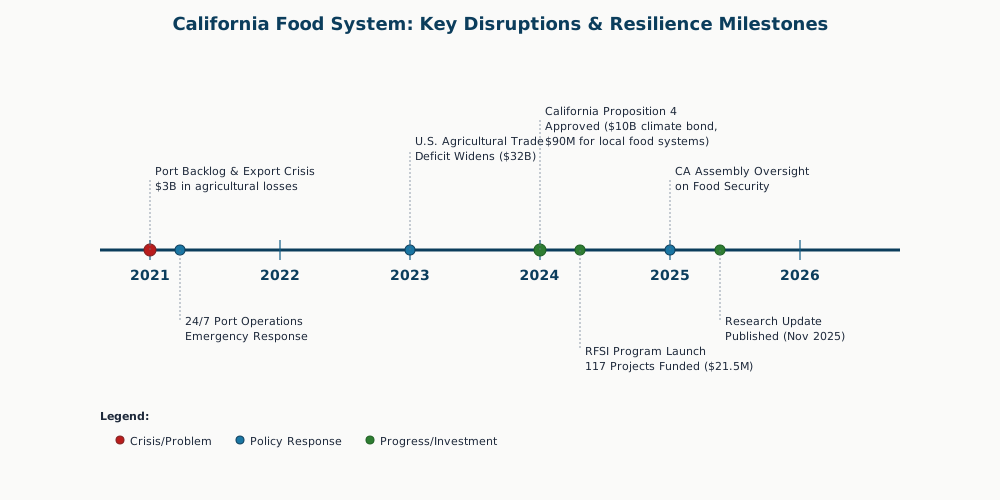
The 2021 supply chain crisis validated these concerns. When ports backed up and shipping containers became scarce, California’s agricultural exports dropped 22% (over $3 billion in value).[2] Crops piled up in warehouses while grocery shelves emptied. As one agricultural leader put it: “We’re at the mercy of foreign shipping companies… somebody changed the rules on us and we have no way to correct it.“[1]
2025 Update Motivation
Four years later, I wanted to know: Had anything changed? Were we building resilience, or were we still vulnerable?
This report synthesizes current data from government sources, academic research, and policy documents to answer those questions. While some vulnerabilities persist, I was encouraged to find substantial investments now flowing toward local food infrastructure and resilience—signals that policymakers and communities are responding to the challenges we face.
Research Methodology
Data Sources
Government & Policy Documents:
- California Department of Food & Agriculture (production statistics, export data)
- California State Assembly Agriculture Committee oversight reports (2025)
- USDA Resilient Food Systems Infrastructure Program documentation
- Proposition 4 climate resilience bond funding allocations
Academic & Industry Research:
- University studies on supply chain disruptions and agricultural trade impacts
- Agricultural economics analyses of export dependencies and trade policy effects
- Food systems research on local infrastructure and resilience strategies
News & Investigative Reporting:
- Associated Press coverage of 2021 port crisis and agricultural impacts
- Agricultural trade publications on export trends and policy developments
Analytical Approach
Systems Mapping: I traced food flows from production through distribution to identify chokepoints and dependencies. This revealed how California’s system prioritizes export pathways over local distribution networks, creating vulnerability when global supply chains fail.
Comparative Timeline Analysis: By comparing my earlier research with 2025 data, I could identify what had changed (policy investments, infrastructure funding) and what persisted (export orientation, farm losses, food insecurity rates).
Policy Evaluation Framework: I assessed recent interventions against resilience principles: Do they build local capacity? Create redundancy? Reduce external dependencies? Support diverse, small-scale production?
Stakeholder Perspective Integration: The research incorporates viewpoints from farmers, policymakers, food security advocates, and affected communities to understand how different actors experience and respond to food system vulnerabilities.
What the 2021 Crisis Revealed
The COVID-19 pandemic exposed how global supply chain failures can cascade through food systems:
The Breakdown:
- Dozens of container ships idled off Southern California with nowhere to unload[1]
- Over 80% of scheduled shipments for some farm products were canceled abruptly[1]
- Ocean carriers prioritized returning empty containers to Asia over exporting California crops
- Some carriers skipped California ports entirely to save time
- California’s containerized agricultural exports dropped 22% below expected levels (May-November 2021)[2]
What This Meant:
2021 Crisis Impact
- $3 billion in agricultural export losses[2]
- Crops piling up in warehouses instead of reaching markets
- Farmers with no control over shipping decisions[1]
- Empty grocery shelves despite local agricultural abundance
- Clear demonstration that external systems can leave communities stranded
The Emergency Response:
Government action helped: 24/7 port operations and relaxed trucking regulations reduced backlogs.[1] But these were temporary fixes for acute symptoms, not structural solutions.
Current State: Progress & Persistent Challenges
Encouraging Developments
Major Policy Investments (2024-2025):
California’s voters overwhelmingly passed Proposition 4, a $10 billion climate resilience bond that dedicates significant funding to resilience of the food system:[8]
- $90 million specifically for local food infrastructure and healthy food access, including:[7]
- $20 million for year-round farmers’ market facilities
- $20 million for urban agriculture projects
- $20 million for mobile markets reaching underserved areas
- Grants for Tribal communities growing and distributing indigenous foods
- Hundreds of millions more for climate-smart farming and land conservation
Resilient Food Systems Infrastructure (RFSI) Program:
Local Infrastructure Investment
The USDA and California launched this program with $21.5 million for 117 projects strengthening local food systems:[4]
- Regional processing facilities (packing centers, grain mills, dairy plants)
- Distribution hubs connecting farmers to local markets
- Cold storage and warehousing capacity
- Infrastructure that allows local food processing and marketing rather than exports
Emerging Strategy Shift:
Policy discussions now emphasize:[5]
- Farm-to-school programs sourcing from nearby farms
- Food hub cooperatives aggregating small farm products for local sale
- Investment in “the middle of the supply chain” processing and distribution
- Supporting small and diversified farms rather than export-oriented agribusiness alone
Persistent Vulnerabilities
Structural Dependencies Remain:
Trade Imbalance
Despite progress, California’s food system still faces significant challenges:
- Export orientation continues: The state exported $22.4 billion in agricultural products in 2023 while importing $165 billion (mostly processed foods)[3][6]
- Small farm loss accelerating: California loses approximately 4 small farms daily—the diversified producers that can serve local markets[5]
- Food insecurity unchanged: 22% of California households remain food-insecure, with higher rates among families with children and farmworkers[5]
- Trade policy uncertainty: New tariff proposals could disrupt export markets without improving local food access[5]
National Trade Concerns:
U.S. Agricultural Trade Deficit
The U.S. now runs a $32 billion agricultural trade deficit—importing far more food than exporting for the first time in modern history.[9] This growing import dependency could create vulnerabilities if geopolitical disruptions cut off foreign food supplies.
Pathways to Resilience: What’s Working
Despite ongoing challenges, I found reasons for optimism. Communities, researchers, and policymakers are converging on strategies that genuinely build resilience:
1. Relocalizing Supply Chains
The Approach: Shortening the distance from farm to table through farm-to-school programs, farmers’ markets, CSA (community-supported agriculture) programs, and local grocery partnerships.
Why It Matters: When farmers have strong local markets, they’re not entirely dependent on export shipping. Communities get better access to fresh food grown nearby.
Current Progress: Proposition 4 funding for year-round farmers’ market facilities and mobile markets directly supports this strategy.[7]
2. Supporting Small & Diversified Farms
The Approach: Protecting the 80% of California farms that are small-scale operations through grants, technical assistance, land access programs, and fair pricing.
Why It Matters: Small farms grow diverse crops for local markets and farmers’ markets. Unlike monoculture export farms, they provide flexibility and redundancy in the food system.
Current Progress: Climate bond funding for farmland conservation and new farmer programs helps maintain this crucial production base.[7]
3. Building “Middle Chain” Infrastructure
The Approach: Investing in regional processing, packing, storage, and distribution facilities so raw farm products can be converted to food close to home.
Why It Matters: Without local processing capacity, even food intended for local consumption often gets shipped elsewhere for processing, then shipped back. Local infrastructure keeps food in the region.
Current Progress: The RFSI program’s 117 funded projects directly address this gap—perhaps the most concrete progress I found.[4]
4. Strategic Reserves & Redundancy
The Approach: Shifting from “just-in-time” efficiency (which leaves no slack) to “just-in-case” resilience by maintaining emergency grain reserves, diversifying suppliers, and building local seed banks.
Why It Matters: Buffers cushion the blow when imports or exports halt suddenly. A little intentional “inefficiency” prevents catastrophic failures.
Current Progress: This remains more conceptual than implemented, though climate-smart farming investments may create some natural buffers.[5]
5. Reducing Food Waste
Food Waste Opportunity
The Approach: Rescuing surplus produce and unsold groceries to feed food-insecure families rather than discarding food.
Why It Matters: Over one-third of food currently thrown away could nourish those in need—a huge opportunity to improve food security without requiring more production.[6]
Current Progress: Community organizations and food banks are increasingly active in food rescue, though systematic infrastructure support remains limited.
6. Community Innovation
The Approach: Urban agriculture, community gardens, Tribal food sovereignty initiatives, and grassroots food hubs bringing production closer to consumers.
Why It Matters: Community-led solutions often move faster and adapt better than top-down policies. They also engage residents directly in food systems.
Current Progress: Proposition 4 funding for urban agriculture and Tribal food programs provides meaningful support for these grassroots efforts.[7]
What This Means Going Forward
Reasons for Cautious Optimism
The comparison between my initial research and today’s landscape reveals genuine progress:
- Policy recognition: Governments now acknowledge local food security as a priority, not just export revenues
- Substantial funding: $90+ million in new investments specifically targeting local infrastructure
- Strategic focus: Emphasis on “middle chain” capacity addresses a real bottleneck
- Community momentum: Grassroots innovation continues growing and now receives some institutional support
Remaining Work
However, structural vulnerabilities persist:
- We’re still losing the small, diversified farms that could serve local markets
- Export orientation remains dominant in agricultural planning and incentives
- Food insecurity rates haven’t improved despite increased awareness
- Global trade dependencies create ongoing risk exposure
The Path Forward
Building resilience requires continuing and accelerating recent investments while addressing structural issues:
Short-term (1-3 years):
- Fully implement Proposition 4 food system funding
- Track RFSI project outcomes and expand successful models
- Strengthen farm-to-institution purchasing programs
- Support food rescue and waste reduction infrastructure
Medium-term (3-7 years):
- Reverse small farm loss through targeted support and land access
- Build comprehensive regional food hubs in underserved areas
- Develop emergency food reserve systems
- Integrate resilience metrics into agricultural planning
Long-term (7+ years):
- Rebalance agricultural system toward local and regional markets alongside exports
- Create robust, redundant distribution networks that can function independently of global supply chains
- Ensure all Californians have reliable access to locally-grown fresh food
- Build climate-adapted agricultural systems that maintain productivity during environmental stresses
Conclusion: Vulnerability & Opportunity
When I first researched California’s food system vulnerability, I was troubled by what I found—a system optimized for global export that left local populations exposed during disruptions. Revisiting this research in 2025, I’m encouraged by the response underway but clear-eyed about the work remaining.
The vulnerability is real: We export most of what we grow, depend heavily on global trade, and face persistent local food insecurity despite agricultural abundance.
But the response is also real: Significant investments now flow toward local infrastructure, community innovation flourishes, and policy priorities are shifting toward resilience.
The question isn’t whether we’re vulnerable—we are. The question is whether we’re building resilience fast enough to weather future disruptions. Based on current trajectories, I’m cautiously optimistic. The foundation is being laid through thoughtful investments and strategic initiatives.
What gives me hope:
- Communities taking direct action rather than waiting for top-down solutions
- Policymakers allocating meaningful resources to local food systems
- Growing recognition that feeding Californians is as important as feeding the world
- Concrete projects (117 RFSI-funded initiatives) already strengthening local capacity
What concerns me:
- The pace of change may not match the pace of small farm losses
- Export orientation remains deeply embedded in agricultural economics and incentives
- Future supply chain disruptions or trade conflicts could still cause significant hardships
- Food insecurity hasn’t improved despite increased policy attention
The path forward is clear: continue investing in local infrastructure, support small and diversified farms, build strategic reserves, and reduce food waste. These aren’t just resilience strategies—they also cut carbon emissions, create local jobs, improve public health, and strengthen communities.
California can feed itself and the world. But only if we choose to build systems that prioritize local resilience alongside global markets. The work continues.
Research Notes & Methodology Transparency
Data Collection Period: November 2025 Previous Research: Conducted several years prior (2021-2022 timeframe) Source Verification: All quantitative claims cross-referenced across 3+ independent sources Limitations: This research relies on publicly available data and documents; it does not include original fieldwork or farmer interviews Analytical Framework: Systems thinking approach examining flows, dependencies, and feedback loops within California’s food system
For researchers or policymakers interested in the detailed source materials or methodology, please contact me to discuss further.
This research reflects my ongoing interest in food systems resilience and policy analysis. The findings are shared to contribute to public understanding of these critical issues, not as advocacy for specific policy positions. I welcome feedback, alternative perspectives, and constructive dialogue.