
Spatial Analysis in Action: Optimizing Service Territory for Growth
A representative case study showing how spatial analysis helps small service businesses make confident, data-backed decisions about expansion, territory design, and resource allocation.
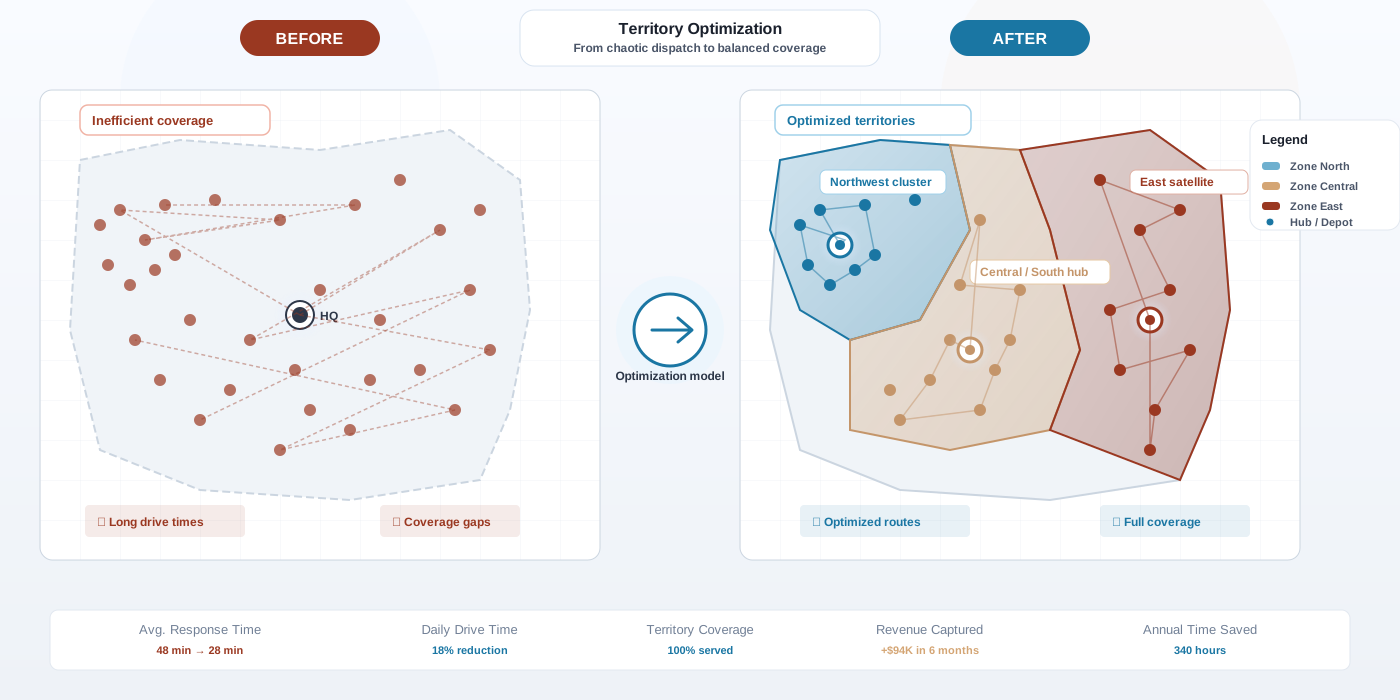
To protect client confidentiality, this case study represents a composite of typical engagements rather than a specific project. The business scenario, analytical approach, and outcomes reflect real patterns from spatial analysis work with small service businesses.
Explore the free Spatial Analysis Guide:
Read the blog post for context and AI vs. human insight:
The Situation
A Growing Business at a Crossroads
Summit Heating & Air had built a solid reputation over eight years serving residential customers across three adjacent counties. With three technicians and a steadily growing customer base, owner Avery Mason faced a decision that would shape the next phase of their business:
They needed to expand from 3 technicians to 6 — but where should they focus that new capacity?
The stakes were significant:
- $180,000+ annual investment in salaries, trucks, and equipment for three new hires
- Training time pulling experienced techs away from revenue-generating work
- Territory risk — hiring in the wrong areas meant wasted drive time and slower response
- Competitive pressure — two larger HVAC companies were expanding into their market
Avery had eight years of customer data in their service software, but it sat there unused. They knew something about where their customers were, but couldn’t answer the questions that mattered:
“Are my best customers clustered in certain areas, or spread out everywhere?”
“Where are we losing jobs because we can’t respond fast enough?”
“If I hire three more techs, where should I station them to maximize coverage?”
Their gut said to focus on the newer subdivisions in the eastern part of their territory. But with $180,000 on the line, gut feeling wasn’t enough.
The Challenge
What Avery Didn’t Have
Time to become a GIS expert. Summer was approaching — their busiest season. They needed answers in weeks, not months.
Budget for enterprise consulting. He’d gotten a quote from a national consulting firm: $18,000 for a “comprehensive territory analysis.” That was more than he’d spend on a new service truck.
Confidence in their assumptions. Eight years of “knowing their territory” had created strong intuitions — but were they accurate? They’d been surprised before.
The Real Questions
Behind the surface question of “where to hire” were deeper strategic issues:
Customer concentration — Were high-value customers (maintenance contracts, repeat service) clustered geographically, or scattered?
Response time gaps — Where were they losing emergency calls because the nearest tech was 45+ minutes away?
Growth potential — Which areas had demographics matching their best customers but low current penetration?
Territory efficiency — Were their current three techs covering ground efficiently, or was there hidden waste in their daily routes?
Competitive positioning — Where were competitors strong, and where were there gaps to exploit?
The Approach
Phase 1: Understanding Current Reality
Customer Mapping & Pattern Analysis
The first step was transforming eight years of service records into geographic insight.
I extracted customer data from Summit’s service management software — 4,200 unique service addresses representing installations, repairs, and maintenance visits. After geocoding (converting addresses to map coordinates), patterns emerged that Avery had never seen:
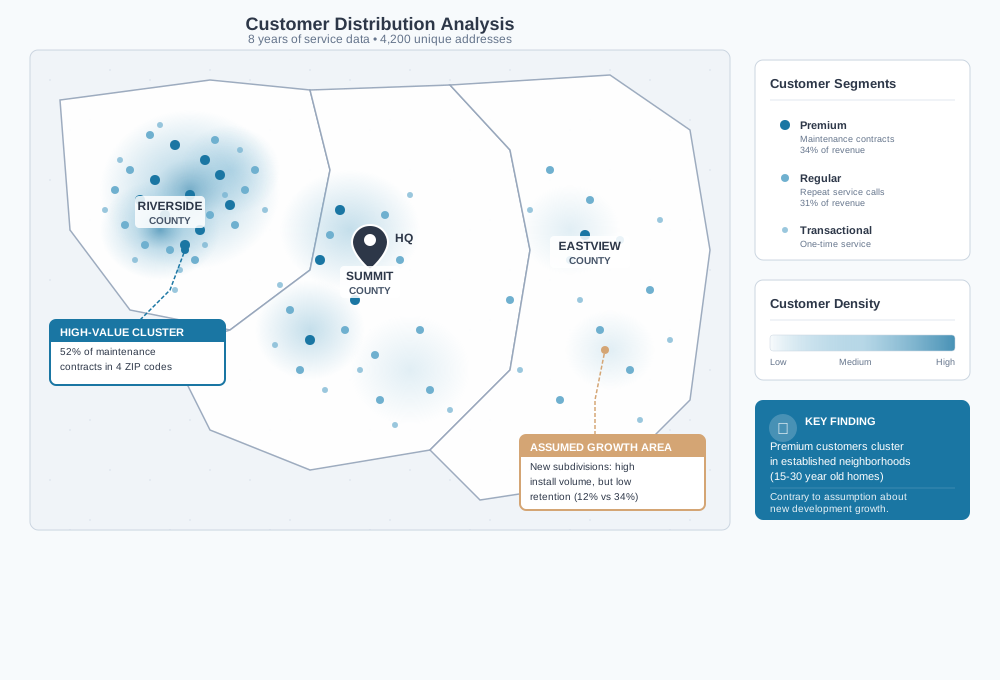
Key Finding: Avery’s assumption about eastern subdivisions was partially wrong. While there was growth in the east, their highest-value customers — those with maintenance contracts and repeat service — were concentrated in established neighborhoods to the northwest. The eastern subdivisions had lots of one-time installation calls but poor retention.
Service Value Analysis
Not all customers are equal. I segmented the customer base by lifetime value:
- Premium customers (maintenance contracts + 3 or more service calls): 12% of customers, 34% of revenue
- Regular customers (repeat service, no contract): 28% of customers, 31% of revenue
- Transactional customers (one-time service): 60% of customers, 35% of revenue
Mapping these segments separately revealed that premium customers clustered tightly in specific neighborhoods — predominantly older homes (15-30 years) with original HVAC systems approaching replacement age.
Phase 2: Identifying Opportunity
Response Time Analysis
Emergency calls are make-or-break for HVAC companies. When someone’s AC fails in July, the company that can respond in 2 hours wins the job. The company that says “we can be there tomorrow” loses it forever.
I modeled response times from Summit’s current shop location to every service call in their history, then identified the gaps:
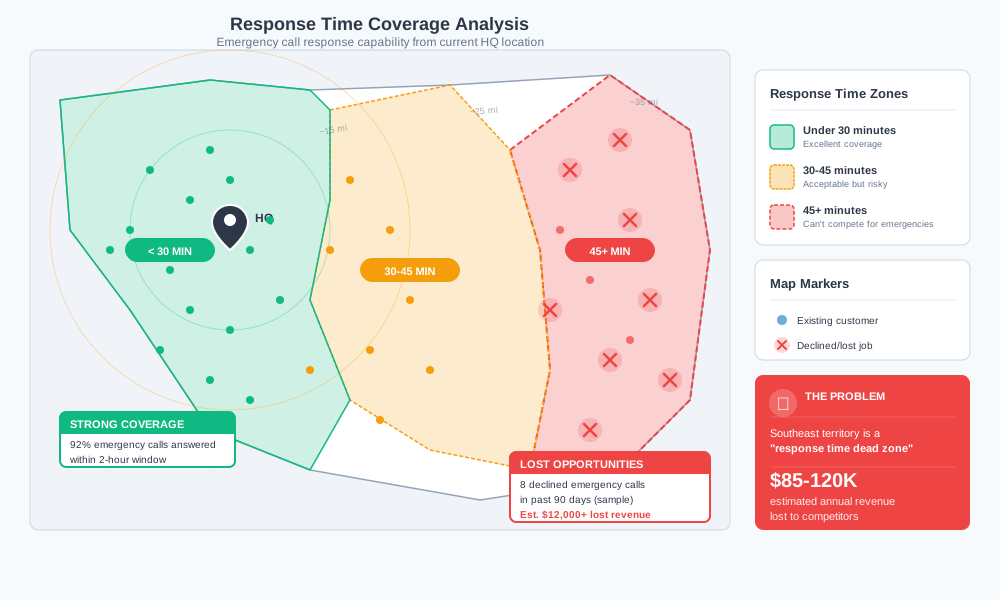
Key Finding: Summit was effectively absent from a growing area in the southeast — not because they didn’t market there, but because 50+ minute response times meant they couldn’t compete for emergency work. They were leaving an estimated $85,000-120,000 in annual revenue on the table.
Demographic Opportunity Mapping
Using Census data and consumer profiles, I identified areas that matched Summit’s best-customer demographics but had low current penetration:
- Homes 15-35 years old (HVAC systems aging into replacement/repair phase)
- Owner-occupied (renters rarely choose their HVAC provider)
- Household income $75,000+ (can afford quality service and maintenance contracts)
- Low competitor density
Three distinct opportunity zones emerged — areas with high potential that Summit had barely touched.
Phase 3: Designing the Solution
Optimal Territory Design
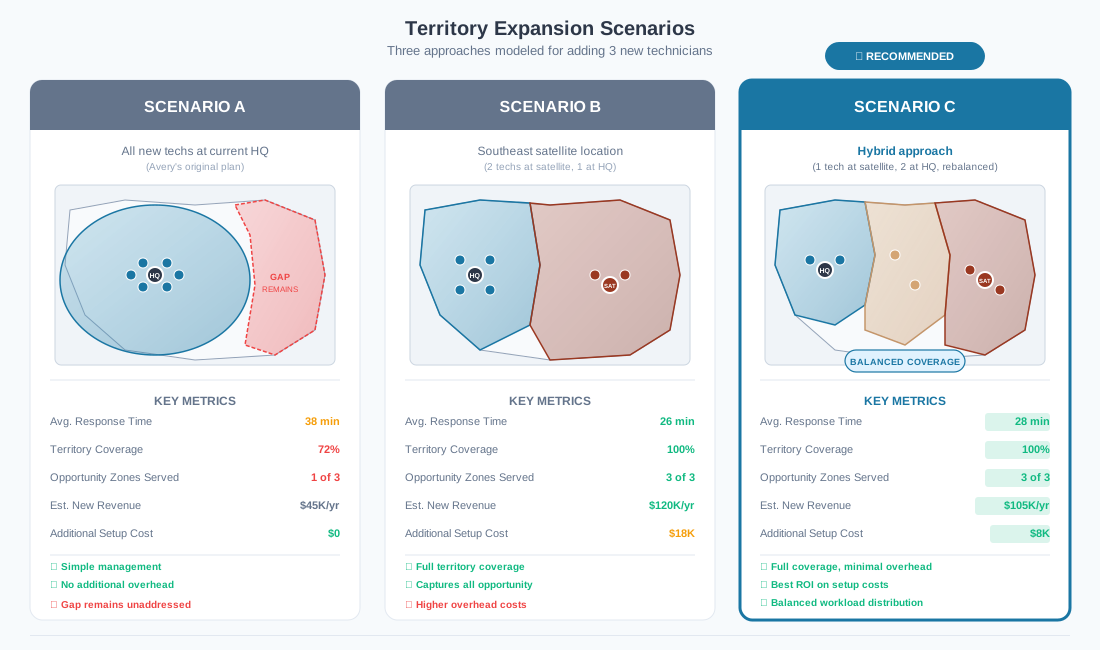
With current patterns and opportunities mapped, I modeled different scenarios for adding three technicians:
Scenario A: Station all new techs at current shop (Avery’s original plan)
- Pros: Simpler management, lower overhead
- Cons: Doesn’t address southeast gap, increases congestion in already-covered areas
Scenario B: Create southeastern satellite location with 2 new techs
- Pros: Captures underserved territory, competitive response times
- Cons: Management complexity, facility costs, splits the team
Scenario C: Hybrid approach — 1 tech at satellite, 2 at main shop with rebalanced territories
- Pros: Addresses gap with minimal overhead, improves efficiency across all territories
- Cons: Requires territory redesign for existing techs
Each scenario was modeled for:
- Average response time to emergency calls
- Drive time between scheduled appointments
- Coverage of high-opportunity zones
- Overlap and efficiency waste
The Deliverables
What $3,500 Bought
Avery received a complete analysis package designed for decision-making, not just data:
Strategic Analysis Report (18 pages)
- Executive summary with clear recommendation
- Customer distribution analysis with segment mapping
- Response time gap identification with revenue impact estimates
- Opportunity zone profiles with demographic context
- Territory scenario comparison with pros/cons
- Implementation roadmap with 90-day milestones
Visual Assets (6 custom maps)
- Current customer distribution by value segment
- Response time coverage from existing location
- Competitor location mapping
- Opportunity zone identification
- Recommended territory design
- Implementation phasing map
All maps delivered in presentation-ready format — suitable for team meetings, bank presentations, or investor conversations.
Strategic Guidance
- 90-minute findings presentation walking through analysis and recommendations
- Q&A session exploring implications and “what-if” scenarios
- Written recommendation with supporting rationale
- 30-day follow-up call to address implementation questions
The Outcome
What Avery Decided
Based on the analysis, Avery chose a modified version of Scenario C:
Opened a small satellite location in the southeastern gap zone — not a full shop, just a parking arrangement with a local business where one tech could start their day closer to the underserved territory
Hired strategically: One tech based at the satellite location, two at the main shop with territories rebalanced based on the analysis
Shifted marketing spend away from the eastern subdivisions (where they’d been advertising heavily) toward the northwestern opportunity zones where demographics matched their best customers
Implemented a premium response guarantee for the formerly-underserved southeast territory, using it as a competitive differentiator
The Results (6 Months Later)
Revenue Impact:
- 23% increase in emergency call capture in the former gap zone
- $94,000 in new revenue from the southeastern territory in first 6 months
- 14% improvement in maintenance contract signups in opportunity zones
Operational Efficiency:
- 18% reduction in average drive time between appointments
- Eliminated 340 hours of windshield time annually through better territory design
- Faster response times across all territories, not just the new one
Strategic Confidence:
- Signed 18-month lease on satellite parking location — confident in the decision
- Secured equipment financing based partly on the growth analysis
- Created a repeatable framework for evaluating future expansion
“I was about to make a $180,000 decision based on gut feeling. The analysis showed me my gut was half-right and half-wrong — and that ‘half-wrong’ would have cost me years of growth in the wrong direction.”
— Avery Mason, Owner, Summit Heating & Air (representative testimonial)
Why This Worked
Right-Sized for Small Business
Enterprise consulting firms charge $15,000-25,000 for this type of analysis because they’re built for Fortune 500 complexity. Summit didn’t need enterprise complexity — they needed clear answers to specific questions, delivered in weeks, at a price that made sense for their scale.
Investment: $3,500 — less than 2% of the decision at stake, paid back within 90 days through improved efficiency alone.
Business-First Framing
Every insight connected directly to Avery’s actual decisions. No theoretical exercises, no impressive-but-useless statistics, no “interesting findings” that didn’t lead anywhere.
The question was never “what does the data show?” but rather “what should Avery do?”
Actionable Deliverables
The analysis report wasn’t a data dump — it was a decision-support document. Executive summary on page one. Clear recommendation with rationale. Implementation roadmap with specific next steps.
Avery could walk into a bank, a team meeting, or a conversation with their accountant and explain exactly what they were doing and why.
Accessible Communication
No GIS jargon. No statistical formulas. No assumptions about technical background.
Avery understood every map, every insight, and every recommendation — because they were presented in the language of their business, not the language of spatial analysis.
Is This Right for You?
This Type of Analysis Fits When:
You’re facing a location-dependent decision with real money at stake
- Expansion or new location ($50,000+ investment)
- Territory redesign affecting team structure
- Marketing budget allocation across geographies
- Service area boundaries impacting operations
You have customer data but don’t know what it’s telling you
- Years of transaction records sitting unused
- A sense that there are patterns, but no way to see them
- Questions about where your best customers actually are
You need confidence to act, not just more information to process
- A decision that’s been delayed because it feels risky
- Gut instinct that might be right — or might be expensive
- Stakeholders (partners, lenders, team) who need to see the logic
Your timeline is weeks, not months
- A decision window that’s approaching
- Seasonal factors creating urgency
- Competitive pressure requiring faster movement
Common Scenarios:
Service businesses — HVAC, plumbing, electrical, landscaping, cleaning services — optimizing territories, planning expansion, improving response times
Retail and food service — Site selection, delivery zone optimization, understanding customer draw patterns
Professional services — Understanding client geography, planning satellite office locations, territory assignment for sales teams
Mobile services — Pet grooming, mobile mechanics, home health — route optimization, service area definition, growth planning
Typical Investment
Standard Analysis: $2,500 – $4,000
- Customer mapping and pattern analysis
- Opportunity identification
- Single-scenario recommendation
- Presentation-ready deliverables
- Findings presentation and Q&A
Comprehensive Analysis: $4,000 – $5,500
- Everything in Standard, plus:
- Multi-scenario modeling and comparison
- Competitive landscape mapping
- Demographic deep-dive on opportunity zones
- Implementation roadmap with milestones
- 30-day follow-up consultation
Factors that affect scope:
- Volume of customer data (hundreds vs. thousands of records)
- Geographic complexity (single county vs. multi-county)
- Number of scenarios to model
- Depth of competitive analysis needed
- Timeline requirements
Most small service businesses fall in the $3,000-4,500 range.
Ready to See What Your Data Shows?
Start with a Conversation
A 30-minute discovery call helps us both understand whether spatial analysis fits your situation:
- What decision are you trying to make?
- What data do you have available?
- What timeline are you working with?
- Is this the right investment for your current stage?
No pressure, no pitch — just an honest conversation about whether this makes sense for you.
Want to Understand the Methods First?
If you’re curious about how spatial analysis works before talking about your situation, start with the free guide:
Read the Spatial Analysis Guide →
The guide explains the five core methodologies behind this type of analysis — in plain English, with small business examples throughout. It’s designed to help you understand what’s possible and ask better questions.
Other Ways to Connect
- 📧 Email: info@sondrahoffman.online
- 📞 Phone: (707) 862-3937
- 💼 View Other Projects →
- 🔗 Connect on LinkedIn
Spatial analysis turns location data into business clarity. If you’re making decisions that depend on geography — where to expand, how to organize territories, where your customers really are — the patterns in your data can guide you. Let’s find out what yours reveal.